
Introduction
I still remember the exact moment I got tired of vendor demos. I was three sales calls deep into researching automation tools for a client’s onboarding workflow, and every single rep told me their product was “revolutionary.” None of them told me why AI automation was different from the clunky rule-based automation I’d been using since 2015. That’s the exact rabbit hole that led me to Droven.io.
If you’re searching for Droven.io enterprise tech innovation, you’re probably in the same boat I was — trying to separate real technology shifts from marketing noise before you commit budget, time, or your team’s patience to something new. I’ve spent a good chunk of the last few months reading through the platform, cross-checking what it says against what I already know as a working analyst, and forming my own opinion. This guide is that opinion, laid out honestly.
I’m not going to sell you anything here. I’m just going to walk you through what I found, what confused me at first, and what I think you should actually pay attention to.
What Is Droven.io Enterprise Tech Innovation?
Quick answer for the skimmers: Droven.io enterprise tech innovation refers to the educational content and analysis published on Droven.io covering how enterprises adopt AI, cloud computing, and workflow automation. It’s not a software product — it’s a knowledge resource that explains these shifts in plain language before you buy anything.
Here’s the thing that took me a minute to wrap my head around: “Droven.io enterprise tech innovation” isn’t a product name or a feature you toggle on. It’s more of a subject area — a lens the platform uses to look at how large organizations are restructuring their tech stacks around Artificial Intelligence, Cloud Computing, and Workflow Automation.
When I first landed on the site, I expected another SaaS homepage with a “Book a Demo” button in the top corner. Instead, I found articles. Actual, structured, reasonably deep articles about how enterprises are rethinking IT infrastructure, where Machine Learning fits into day-to-day operations, and what security frameworks like Zero Trust Architecture mean for companies moving workloads to the cloud.
That distinction matters more than it sounds like it should. Have you ever tried to research a technology category only to find every single result was secretly trying to sell you something? That’s the gap Droven.io seems to be filling.
Is Droven.io a Software Product or an Editorial Platform?
This is probably the most common point of confusion, and I want to clear it up right away because I made this assumption myself at first.
Droven.io is an editorial platform, not a software product. It doesn’t run automations for you, connect your CRM to your email tool, or process your data. What it does is explain, analyze, and contextualize the tools and trends that do those things. Think of it less like Zapier or Make, and more like a technology analyst writing for a general audience.
Here’s why that distinction is actually useful:
- No sales pressure. Nobody’s trying to upsell you mid-article.
- No vendor bias built into the recommendations — at least not the obvious kind you see on affiliate-heavy comparison sites.
- You can read it before you’ve even decided what problem you’re solving. That’s rare. Most tech content assumes you already know what you need.
Honestly, this confused me for about five minutes the first time I read through a few pages, because so much of the AI content space right now blurs the line between “we’re explaining this” and “we’re selling this.” Droven.io leans editorial. Whether that stays true as the platform grows, I genuinely don’t know — but as of my research, that’s the model.
My Personal Experience with Droven.io Enterprise Tech Innovation
Okay, story time.
A few months back, I was helping a mid-sized logistics company figure out whether they should invest in an AI-driven scheduling system or just optimize their existing rule-based automation. Their ops manager kept asking me the same question in different ways: “Is this actually going to save us money, or are we just chasing a trend?” Fair question. I didn’t have a confident answer yet.
So I did what I usually do — I started reading. I spent an evening (coffee in hand, obviously) going through Droven.io’s coverage of AI automation and enterprise adoption patterns. A few things stood out to me:
- The content didn’t oversell AI. A lot of what I read acknowledged the failure points — things like unclear use cases, messy data, and unrealistic expectations — instead of just hyping up the upside. That’s not something I see often in this space.
- It gave me vocabulary I could use with the client. Reading through explanations of how AI-driven workflows differ from static, rule-based automation helped me articulate the tradeoffs in a way that didn’t require the ops manager to have an engineering degree.
- I still had to do my own homework. Droven.io didn’t hand me a final answer, and honestly, I wouldn’t trust a platform that claimed to. What it gave me was a clearer mental framework to evaluate the options myself.
In the end, we went with a hybrid approach — AI-assisted scheduling layered on top of their existing rules engine, not a full rip-and-replace. I can’t say Droven.io made that decision for me, but it absolutely sharpened the questions I asked before I got there. That’s the honest takeaway: it’s a research layer, not a decision-maker. If you’re expecting it to spit out a verdict, you’ll be disappointed. If you’re using it to get smarter before you make your own call, it does that job well.
What Enterprise AI Tools Are Covered on Droven.io?
Quick answer for the skimmers: Droven.io covers the categories of enterprise AI tools rather than acting as a vendor itself — this includes workflow automation platforms, machine learning infrastructure, cloud-based AI services, and cybersecurity frameworks relevant to enterprise adoption.
From what I’ve seen browsing the platform, the coverage spans a fairly wide net:
- Workflow Automation and RPA — the tools businesses use to cut down on repetitive manual tasks.
- Machine Learning infrastructure — how enterprises build and deploy ML models at scale.
- Cloud Computing services — the backbone that makes most enterprise AI actually run.
- Cybersecurity and Zero Trust Architecture — because none of this matters if your data isn’t protected.
- AI for business operations — customer service, document processing, lead qualification, and similar use cases.
I’ll be upfront: I haven’t independently verified every single tool or vendor mentioned across the site, and I’m not going to pretend I have. What I can say is that the categories covered line up with what enterprise IT teams are actually dealing with right now — not some hypothetical future stack.
How Does AI Automation Transform Enterprise Workflows?
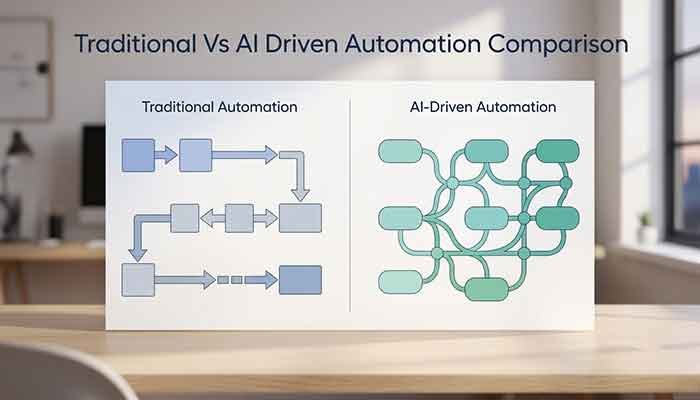
This is the part that gets people excited, and honestly, it’s the part I find most interesting too.
Traditional workflow automation follows fixed rules. If X happens, do Y. It’s reliable, but it’s rigid — the second a situation falls outside the rules you defined, the automation breaks or does something wrong. AI-driven automation changes that equation by adding a layer of interpretation on top of the rules.
Here’s what that looks like in practice:
- Document processing that can read and classify unstructured text, not just pull data from fixed fields.
- Customer service workflows that understand intent, not just keyword matches.
- Lead qualification that scores prospects based on patterns, not a static checklist.
- Data routing that adapts based on context instead of a rigid decision tree.
Does this sound familiar if you’ve ever fought with an old-school automation tool that broke the moment a customer typed something slightly unexpected? That’s exactly the pain point AI automation is designed to solve. It doesn’t eliminate the need for rules entirely — it makes the rules smarter and more forgiving.
What Is the Difference Between Traditional Automation and AI-Driven Automation?
I get asked this constantly, so let me put it in a simple table, because I think this is one of those things that’s easier to see side-by-side than explain in paragraphs.
| Feature | Traditional Automation | AI-Driven Automation |
|---|---|---|
| Logic type | Fixed if/then rules | Adaptive, context-aware decisions |
| Handles unstructured data | Poorly or not at all | Yes — text, documents, natural language |
| Maintenance | Breaks when inputs change | More resilient to variation |
| Setup complexity | Usually simpler, faster to deploy | Higher upfront complexity, more data needed |
| Best for | Repetitive, predictable tasks | Tasks involving judgment or variability |
| Example | Auto-forwarding emails by subject line | Auto-categorizing support tickets by intent |
| Cost over time | Lower initial cost, higher manual patching | Higher initial investment, lower long-term friction |
My honest opinion after using both types of systems for clients: traditional automation still wins for dead-simple, predictable tasks. Don’t let anyone convince you every workflow needs AI slapped on top of it. AI automation earns its keep when the task involves ambiguity — language, judgment calls, or data that doesn’t fit neatly into fields.
Is Droven.io Free to Access for Tech Education?
Yes — based on everything I’ve seen, Droven.io operates as a free, publicly accessible content platform. There’s no paywall blocking articles, and I haven’t come across a subscription tier or premium content gate during my time on the site.
That’s actually a meaningful part of what makes it useful as a starting point. You’re not committing money before you even understand the category you’re researching. I’d still recommend treating it as one input among several — cross-reference what you read with vendor documentation, industry reports, and, frankly, people who’ve actually implemented the tools you’re considering.
How Do Enterprise Software Solutions Integrate With AI Platforms?
This is where a lot of businesses get stuck, and it’s worth breaking down honestly rather than glossing over.
Enterprise software doesn’t usually integrate with AI platforms through some magic plug-and-play switch. It typically happens through:
API Connections
Most modern enterprise tools (CRMs, ERPs, ticketing systems) expose APIs that AI platforms can hook into. This is the most common integration path.
Webhooks and Event Triggers
Instead of constant polling, systems send real-time signals when something changes — a new lead, a support ticket, an inventory update — which the AI layer can then act on.
Middleware and Orchestration Layers
Tools like workflow orchestration platforms sit between your existing software and your AI models, translating data formats and managing the handoffs.
Here’s my honest take: integration is almost always the hardest, least glamorous part of the whole process. Nobody posts a LinkedIn update about how they spent three weeks debugging a webhook. But that unglamorous work is where most AI automation projects actually succeed or fail.
What Cloud Security Standards Does Droven.io Cover?
Security is one of those topics I wish more AI-focused content took seriously, and it’s an area Droven.io does address, particularly around Zero Trust Architecture.
Zero Trust, if you’re not familiar, flips the old security model on its head. Instead of assuming anything inside your network perimeter is safe, it assumes nothing is trusted by default — every request gets verified, regardless of where it originates. As more enterprise workloads move to the cloud and more AI systems need access to sensitive data, this model has become less of a “nice to have” and more of a baseline expectation.
From what I’ve read, coverage in this space touches on:
- Identity and access management principles
- Data encryption practices for cloud-hosted AI systems
- The general logic behind Zero Trust as an enterprise security philosophy
I’ll flag one honest limitation here: security implementation details vary enormously by organization, compliance requirement, and industry. Content like this is a great primer, but it’s not a substitute for a real security audit from someone who knows your specific environment.
Read More: Brumeblog Com Review: Is It Safe & Legit?
How Can Businesses Evaluate AI Automation Tools?
After years of watching companies (including my own clients) either overinvest in shiny AI tools or underinvest out of fear, I’ve landed on a pretty simple evaluation framework. I don’t think it’s revolutionary — but I do think it’s honest.
- Start with the problem, not the tool. If you can’t clearly state the workflow that’s broken, no AI tool will fix it.
- Check your data readiness. AI automation is only as good as the data feeding it. Messy, inconsistent data will sabotage even the best tool.
- Ask about failure modes, not just success stories. Every vendor will show you a case study. Ask what happens when the tool gets it wrong.
- Pilot before you commit. Small-scale tests reveal problems that sales demos never will.
- Factor in maintenance, not just setup cost. AI systems need monitoring and occasional retraining — budget for that reality upfront.
I genuinely believe this last point is the one businesses skip most often. Everyone budgets for the software license. Almost nobody budgets for the ongoing attention the system needs to stay accurate.
What Role Does Cloud Infrastructure Play in Enterprise Digital Transformation?

Quick answer for the skimmers: Cloud infrastructure is the foundation that makes enterprise AI, automation, and digital transformation possible at scale — providing the computing power, storage, and flexibility that on-premise systems typically can’t match.
I don’t think it’s an exaggeration to say cloud computing is the quiet backbone underneath almost every AI enterprise story you hear about. It’s rarely the headline, but it’s almost always the thing making the headline possible. A few reasons why:
Read More: Backtofrontshow Pricing Guide: Plans & Costs 2026
Scalability Without the Hardware Headache
Enterprises don’t need to predict their compute needs years in advance and buy servers accordingly. Cloud infrastructure lets them scale up or down based on actual demand.
Access to Managed AI and ML Services
Most major cloud providers now offer managed machine learning services, which means enterprises don’t need to build every model from scratch in-house.
Centralized Data for Better Automation
AI automation works best with consolidated, accessible data. Cloud storage makes that consolidation far more practical than scattered on-premise systems.
Here’s my honest opinion: companies that treat “cloud migration” and “AI adoption” as two separate projects usually struggle more than companies that plan them together from the start. They’re deeply intertwined, whether the org chart reflects that or not.
FAQ: What People Are Actually Asking
Is Droven.io affiliated with any specific AI vendor?
Based on my research, Droven.io positions itself as vendor-neutral editorial content rather than a vendor-affiliated marketplace. I’d still recommend verifying any specific claims directly, since vendor relationships in this space can shift over time.
Do I need technical experience to understand Droven.io’s content?
No. From what I’ve read, the content is written for a general business and tech-curious audience, not exclusively for engineers. That’s actually one of its strengths — it doesn’t assume you already speak fluent AI jargon.
Can Droven.io replace hiring a consultant or automation specialist?
Not in my opinion. It’s a research and education resource, not an implementation partner. Think of it as the step before you talk to a specialist, not a replacement for one.
How often is Droven.io’s content updated?
I don’t have confirmed details on their publishing cadence, so I won’t guess. If update frequency matters for your use case, I’d check the site directly for publish or revision dates on specific articles.
Is Droven.io only relevant for US-based businesses?
Much of the content I encountered leans toward a US market context, but the underlying concepts — AI automation, cloud infrastructure, Zero Trust security — apply globally. The examples may skew American; the principles generally don’t.
Conclusion: Martin’s Final Tip
If there’s one thing I want you to walk away with, it’s this: don’t let anyone, including me, make your AI adoption decision for you. Platforms like Droven.io are genuinely useful for building the vocabulary and context you need before you evaluate real tools — but the final call still has to come from understanding your own workflows, your own data, and your own team’s readiness.
Martin’s Final Tip: Before you research a single AI tool, write down the exact problem you’re trying to solve in one sentence. If you can’t do that, you’re not ready to shop — you’re ready to research. Start there.
Have you had a chance to dig into enterprise AI content sources like this yet? I’d genuinely love to hear what you found confusing or helpful — drop a comment or reach out, and let’s compare notes over the next round of coffee.