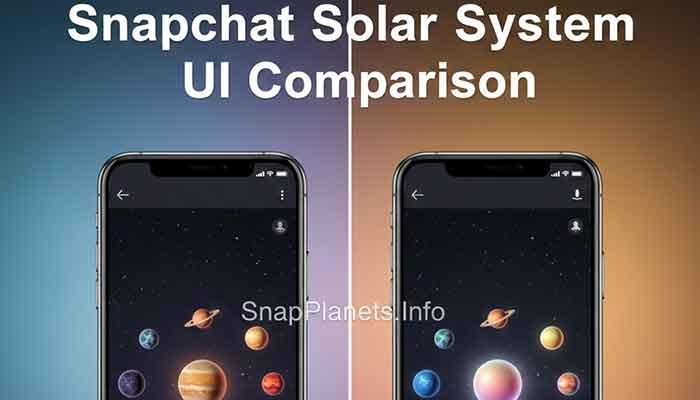
Hey there! I’m Martin. If you’re anything like me, you’ve probably spent way too much time staring at those tiny digital planets on Snapchat, wondering why you’re suddenly someone’s “Mars” instead of their “Mercury.”
A few months ago, I was sitting in a coffee shop with my friend Sarah. I’m a dedicated Android guy (currently rocking the S25 Ultra), and she’s a die-hard iPhone user. We both have Snapchat Plus, and we started comparing our Friend Solar Systems. Within five minutes, we realized that even though we were looking at the same feature, our experiences—and even how the planets looked—weren’t exactly identical.
That afternoon sparked a deep dive into the Snapchat Planets Android vs iPhone debate. Is one platform actually better for your “cosmic” social life, or is it all just space dust? Let’s break it down.
My Personal Experience with Snapchat Planets
Last year, I decided to run a little experiment. I carried an iPhone 15 Pro and my Samsung Galaxy side-by-side for a week. I wanted to see if app performance or the planet icon differences were real or just “green bubble” paranoia.
Here’s what I noticed: On my Android, the Snapchat Solar System feature felt a bit “heavier.” When I tapped the “Best Friends” badge to see my planetary rank, there was a micro-second of lag that just wasn’t there on the iPhone. But the real kicker? The colors. On the iPhone’s OLED screen, the “Earth” planet looked incredibly crisp and vibrant. On my Android, it felt slightly more compressed, like the image hadn’t fully rendered at its highest resolution.
I also noticed that Snapchat Plus platform updates often hit the iOS version first. One Tuesday, Sarah got a new set of custom app icons that I didn’t see on my Play Store update until Thursday morning. It’s a small thing, but for a power user, those 48 hours feel like an eternity!
Read More: Snapchat Solar System Sun: Why You’re the Center
Snapchat Planets Android vs iPhone: The Great Divide?
When we talk about the Snapchat Planets Android vs iPhone experience, we aren’t just talking about different emojis. We’re talking about how the app interacts with your phone’s “brain.”
App Performance and Optimization
Historically, Snapchat has always been an “iPhone-first” app. Why? Because it’s easier for developers to optimize for five iPhone models than for 500 different Android devices.
- iOS Performance: Everything is buttery smooth. The transition from the chat screen to the Friend Solar System is seamless.
- Android Performance: While high-end flagship phones (like the S25 or Pixel 9) handle it well, mid-range Androids often struggle with the AR elements and 3D rendering of the planets.
Planet Icon Differences: Do They Look Different?
You might be wondering if Mercury looks like a potato on Android while looking like a masterpiece on iPhone. Not exactly. The planet icon differences are subtle:
- Rendering: iOS uses Apple’s Metal API, making the 3D planets look a bit more “glossy.”
- Resolution: Some Android users report that the planet icons appear slightly blurry if the app hasn’t been optimized for their specific screen aspect ratio.
- UI Placement: On iPhone, the “Best Friends” badge is usually perfectly centered. On some Android skins (like OnePlus or Xiaomi), the UI elements can occasionally overlap if you have “Display Scaling” turned up.
The Snapchat Plus Experience: Does the Platform Matter?
The Snapchat Plus platform you choose actually dictates how quickly you get to play with new toys. Snapchat+ is the “VIP club” where the Solar System lives, but the velvet rope moves faster for Apple users.
Feature Rollouts
In my experience, experimental features—like the “Imagine” AI Lens or new Ghost Trail updates—tend to land on iOS a few days before they hit the Google Play Store. If you’re a “first adopter” type of person, this can be a bit frustrating.
Platform-Specific Perks
Interestingly, Android users actually have a slight edge in customization. Android allows for more flexibility with background processes, meaning some “Live Activities” or widget-based Snapchat features can sometimes be more functional than their iOS counterparts, which are locked down by Apple’s strict privacy walls.
Comparison: Android vs. iOS for Snapchat Power Users
To make it easier, I’ve put together this quick-reference table based on my testing and the current 2026 app builds.
| Feature | Android Experience | iOS (iPhone) Experience |
| Solar System Load Time | Variable (Hardware dependent) | Consistently Fast |
| Planet Visual Quality | Good (but can be compressed) | Excellent (High Fidelity) |
| Snapchat+ Updates | Usually 2-3 days later | Immediate |
| Camera Integration | Improving (S25/Pixel 9 are great) | Native & Highly Optimized |
| UI Stability | Occasional “glitches” on mid-range | Very Stable |
Frequently Asked Questions
1. Does having an Android make me rank lower in the Solar System?
Answer: Definitely not! Your rank (Mercury, Venus, etc.) is based strictly on how much you interact with someone. Whether you’re sending snaps from a $2,000 Foldable or a 5-year-old iPhone, the math stays the same.
2. Why can’t I see the Solar System badge on my Android?
Answer: First, make sure you have an active Snapchat Plus subscription. Second, check if the “Solar System” toggle is turned on in your Snapchat+ settings. If it’s still missing, try clearing your app cache—Android is notorious for “ghosting” new UI updates until the cache is wiped.
3. Are the planets more accurate on iPhone?
Answer: The “accuracy” (who is #1 vs #2) is identical. The only difference is the visual polish. Think of it like watching the same movie on a 4K TV (iPhone) vs. a 1080p TV (Android). The story is the same, but one looks a bit sharper.
4. Is Snapchat Plus cheaper on one platform?
Answer: Usually, the price is the same ($3.99/month), but sometimes the Google Play Store or Apple App Store might have different tax rates or regional currency conversions. Always check your specific store!
Conclusion: Martin’s Final Tip
At the end of the day, the Snapchat Planets Android vs iPhone debate comes down to one thing: Optimization. If you want the most “polished” version of the solar system, iPhone wins by a hair. But if you’re using a modern Android flagship, the gap is so small you’d need a telescope to see it.
Martin’s Final Tip: If your planets are looking a bit laggy on Android, go into your settings and turn off “Battery Saver” for Snapchat. It allows the app to use the full power of your GPU to render those 3D planets properly!
What about you? Have you noticed your friend’s iPhone looks different than your Galaxy when checking your “Planet” status? Drop a comment or send me a snap—I’d love to hear if you’ve found any other weird differences!
Would you like me to create a step-by-step guide on how to troubleshoot Snapchat Plus features specifically for your Android model?