Hello there! I’m Martin. If you’re like me, you probably spend a little too much time wondering why your best friend suddenly dropped from Mercury to Mars in your Snapchat Solar System. Was it that one day you forgot to reply? Or did they start a secret streak with someone else?
I’ve been a Snapchat power user since the days of the original “Best Friends” list (remember how public and chaotic that was?), and I’ve spent the last few months obsessively testing how the Snapchat interaction score actually works. Grab a coffee, and let’s break down the science behind these digital orbits.
My Personal Experience with the Planet “Demotion”
A few months ago, my younger sister called me out because I was “only” Earth in her Solar System. Now, I’m a tech guy, so I took that as a personal challenge. We had a 400-day streak, but apparently, that wasn’t enough to keep me at Mercury.
I decided to run a little experiment. For one week, we stopped sending our usual “streak-only” blank photos and started actually chatting—sending voice notes, reacting to stories, and playing those tiny in-app games.
The result? Within three days, I jumped from Earth to Venus. By the end of the week, I was back at Mercury.
What I learned is that the Snapchat interaction score isn’t just about the number of days you’ve been snapping; it’s about the depth and variety of those interactions. If you’re just sending one “S” snap a day to keep a streak alive, the algorithm sees that as low-effort. It wants to see real engagement.
Read More: What Happens to Your Planet Rank If You Are Blocked?
How Are Planets Calculated? (The Secret Sauce)
Snapchat is famously tight-lipped about the exact math, but through community testing and my own “field research,” we can pinpoint exactly what moves the needle.
It’s a Weighted System
The algorithm doesn’t treat every action equally. Think of it like a points system where some actions are worth a “Gold Medal” and others are just a “Participation Trophy.”
- Sent vs. Received: It’s a two-way street. If you send 100 snaps but they never reply, your rank won’t budge. The score relies on reciprocity.
- Snap Variety: Sending a video snap often carries more “weight” than a static photo.
- Chat Frequency: This is the big one people miss. Texting within the app is a massive part of the Snapchat interaction score.
The “Recency” Factor
Snapchat’s Solar System is incredibly moody. It favors what you did today over what you did last month. If you have a massive burst of interaction with a new friend over 48 hours, they can rocket past a long-term best friend who you haven’t talked to much lately.
Chat Weightage: Does Texting Actually Count?
One of the biggest myths I hear is that “only Snaps count toward your rank.” Totally false.
In my testing, chat weightage is actually one of the most potent ways to climb the ranks. Why? Because chatting implies a higher level of social engagement than just tapping “Send To” on a photo of your ceiling.
What Counts in Chat:
- Direct Messages: Quick back-and-forth texts.
- Voice Notes: These seem to have a high “engagement value.”
- Sticker Reactions: When you react to their specific message or story.
- Media Sharing: Sending links or photos from your camera roll into the chat.
Martin’s Note: If you’re trying to move up in someone’s Solar System, stop sending “mass snaps” and start having actual conversations in the Chat tab. It’s the fastest “cheat code” I’ve found.
Snapstreak vs. Rank: The Great Debate

Have you ever had a 500-day streak with someone but they aren’t even in your top 3 planets? It’s frustrating, right?
Here’s the deal: Snapstreaks are a measure of consistency, while Planets are a measure of intensity.
| Feature | What it Measures | Affects Planet Rank? |
| Snapstreak | Consecutive days of snapping. | Yes, but minimally. |
| Interaction Score | Total volume and variety of activity. | Primary Driver. |
| Story Views | How often you watch their content. | Slightly. |
| Chatting | Back-and-forth text/voice messaging. | High Impact. |
If you have a long streak but low interaction (e.g., one snap a day), you might stay at Saturn or Uranus. To hit Mercury, you need high volume and high frequency.
The 8 Planets Explained (And What They Say About You)
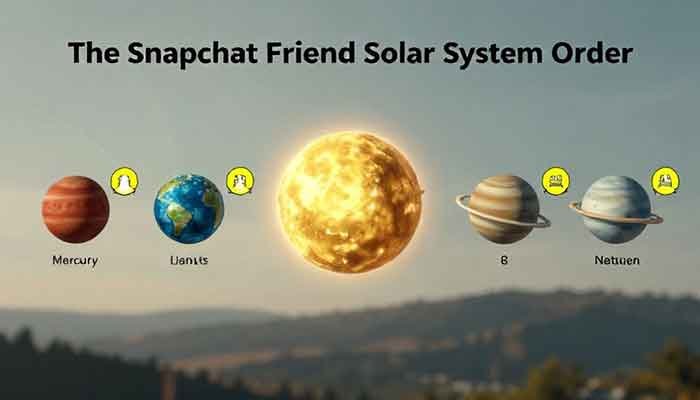
When you tap that “Best Friends” badge on a friend’s profile (if you have Snapchat+), you’ll see your Bitmoji as a planet. Here is the hierarchy from “Ride or Die” to “We Talk Sometimes.”
1. Mercury (#1 Best Friend)
The closest to the Sun. This person is your absolute go-to. You likely snap them multiple times an hour and have a high Snapchat interaction score together.
2. Venus (#2 Best Friend)
The second closest. You guys are tight, but maybe you don’t talk every single hour.
3. Earth (#3 Best Friend)
A solid, reliable friendship. You’re definitely in the inner circle, but there’s a slight gap between you and the top two.
4. Mars (#4 Best Friend)
The “BFF” boundary. You’re still close, but you might notice you go a day or two without deep conversation.
5. Jupiter, Saturn, Uranus, & Neptune
As you get further out, the “frequency” drops significantly. If you’re Neptune (#8), it means you’re just barely hanging onto their top 8 list.
Visual Roadmap: The Solar System Journey
FAQ: Your Burning Questions Answered
Q: Can I see someone else’s full Solar System?
Nope! And honestly, that’s a good thing. You can only see your own position in a friend’s system, and they can see theirs in yours. It keeps the drama to a minimum… mostly.
Q: Does my rank update instantly?
Usually, no. I’ve noticed the Snapchat interaction score and planet positions tend to refresh every 24 to 48 hours. If you spend all day chatting, don’t expect to jump to Mercury until tomorrow morning.
Q: Why did I disappear from someone’s Solar System entirely?
This usually happens for two reasons: either your interaction dropped so low that someone else “out-snapped” you for the #8 spot, or one of you blocked/removed the other. If you’re still friends, you just need to up your game!
Q: Does “Ghost Mode” or “Half-Swiping” affect my rank?
Ghost Mode (on the Map) doesn’t affect your score. However, “half-swiping” to read a message without opening it does count against you because the app doesn’t register the message as “read” or “interacted with.” If you want the points, you gotta open the chat!
Martin’s Final Tip
If you really want to climb the ranks and hit that Mercury status, stop being a passive viewer. Don’t just watch their stories—reply to them. Don’t just maintain a streak—send a voice note about your day. The Snapchat interaction score rewards “Human” behavior, not bot-like consistency.
Would you like me to create a custom 7-day “Mercury Challenge” plan to help you boost your rank with a specific friend?