Hey there! I’m Martin. If you’ve spent any time on Snapchat recently, you’ve probably noticed that things feel a bit more… celestial. As a self-proclaimed Snapchat Power User and tech geek, I’ve spent way too many hours deconstructing how this app decides who orbits closest to us.
Have you ever looked at your Friend Solar System and wondered why your cousin is suddenly Mercury while your best friend since 3rd grade has drifted all the way out to Neptune? It’s not just random luck. In 2026, the Snapchat Solar System algorithm has become more nuanced than ever. It’s a mix of data science and digital body language, and today, I’m going to pull back the curtain on how it actually works.
My Personal Experience with the Snapchat Solar System Algorithm
A few months ago, I decided to run a little experiment. I have two close friends, Leo and Sarah. For years, Leo was my undisputed “Mercury.” We had a massive streak, and we sent each other everything from breakfast photos to midnight rants.
Then, I started a project with Sarah. Suddenly, we were sending dozens of quick chats, sharing links to research, and doing quick video calls every afternoon. I barely sent her any “classic” snaps—you know, the ones with the filters and the 10-second timers—but we were talking constantly.
Within ten days, the algorithm shifted. Leo, despite our 800-day streak, was bumped to Venus. Sarah took the center stage as Mercury.
What did I learn? The Snapchat Solar System algorithm doesn’t just care about streaks or the number of days you’ve been friends. It’s obsessed with recency and depth. The “quality” of interaction—like those long chat sessions and video calls—started weighing more heavily than the mindless “S” snaps I was sending Leo just to keep a number alive. Honestly, it felt a little cold-blooded of the app to demote my bro like that, but it was a wake-up call on how the 2026 update truly values active engagement over habit.
Read More: Pinning Best Friend Snapchat Rank: Does It Change Planets?
The Core of the Galaxy: How Snapchat Ranks Friends in 2026
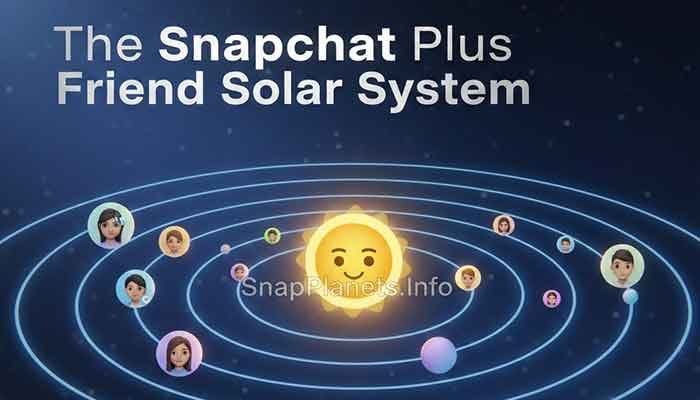
The Snapchat Solar System algorithm essentially treats your social life like a miniature universe. You are the Sun, and your top eight friends are the planets. Their distance from you is determined by an invisible interaction score.
The Interaction Score: The “Secret Sauce”
Snapchat doesn’t give you a raw number, but behind the scenes, every tap and swipe adds up. In the 2026 update, the weight of different actions has shifted. It’s no longer just a 1:1 point system.
- Snap Frequency: Still the king. Sending a photo or video is the strongest signal that you’re “in the moment” with someone.
- Chat Depth: This is where the 2026 update really shines. Long-form chatting (actually typing out sentences!) ranks higher than sending a single emoji or a “gmg” (good morning) message.
- Story Engagement: If you’re the first person to view a friend’s story every time they post, the algorithm takes note. It assumes you’re highly interested in their life.
- Reciprocity: This is huge. If you send 50 snaps but they only open two, your score won’t climb as fast as a friend who replies to every single one.
Breaking Down the 2026 Update: What Changed?
If you feel like your rankings are more “jittery” lately, you aren’t imagining it. The Snapchat Solar System algorithm was tweaked in early 2026 to prevent “rank camping.”
1. The Decay Factor
In the past, you could hold the Mercury spot for months just by having a massive streak. Now, there is a “decay factor.” If your interaction volume drops for even 48 hours, the algorithm begins to “cool” that relationship. It’s designed to reflect your current social circle, not your history from three years ago.
2. Multi-Media Weighting
Snapchat wants you using its features. Using AR lenses together, playing Snap Games, or sharing your location on the Map with a specific friend now provides “bonus points” toward your planetary ranking.
3. The “Mute” Impact
Here’s a tip: if you mute someone’s stories or notifications, the algorithm takes that as a massive signal to move them toward the outer rim (Uranus or Neptune), regardless of how many snaps you exchange. It assumes the relationship is becoming a “chore” rather than an interest.
Decoding the Planets: What Your Position Means
Not all orbits are created equal. Here is how the Snapchat Solar System algorithm assigns the specific planets based on your rank in their list:
| Planet | Rank | Sentiment / Meaning in 2026 |
| Mercury | #1 | The Inner Circle. Your digital twin. |
| Venus | #2 | The Bestie. Constant, high-level interaction. |
| Earth | #3 | The Core Friend. Frequent, reliable connection. |
| Mars | #4 | The Close Buddy. Frequent chats, but maybe fewer snaps. |
| Jupiter | #5 | The Regular. You’re in their “inner circle,” but on the edge. |
| Saturn | #6 | The Consistent Contact. You talk weekly, but not daily. |
| Uranus | #7 | The Casual Friend. Periodic interactions. |
| Neptune | #8 | The Outer Rim. You’re still a “Best Friend,” but barely. |
Deep Dive: How to Influence Your Orbit
Does this sound familiar: you’re Neptune in someone’s system, and you want to be Earth? You can’t “hack” the system, but you can definitely influence it.
- Move Beyond the Streak: Don’t just send a “blank” snap. The algorithm now detects “low-effort” snaps. Add text, use a filter, or—better yet—send a video with sound.
- Initiate Conversations: Being the person who starts the chat usually gives a slight “initiator bonus” in the scoring system for the first few interactions of the day.
- The Power of Video: Since the 2026 update, video calls (even short ones) are weighted nearly 3x higher than a standard text chat. If you want to jump ranks, hop on a quick call.
FAQ: What the Internet is Asking
1. Can my friends see their rank in my Solar System?
No. This is a common point of anxiety. Your Solar System is private to you. They can only see their own position in your system if they have Snapchat+ and tap on your “Best Friends” badge. They can’t see who else is in your top 8.
2. Why did my planet disappear?
If you or your friend hasn’t interacted in over a week, or if you’ve been “outpaced” by 8 other people, the planet will vanish. It just means you’ve dropped out of the top 8 “Best Friends” list.
3. Does “My AI” count toward the Solar System?
Actually, yes. If you treat the AI like a real person—snapping it and chatting with it constantly—it can absolutely take a spot in your Solar System. (A bit lonely, maybe, but the algorithm doesn’t judge!)
4. How often does the algorithm update?
In 2026, the rankings update roughly every 24 to 48 hours. It’s no longer an instant change, which prevents the planets from “flickering” back and forth during a single long conversation.
Martin’s Final Tip: Don’t Let the Planets Stress You Out
Look, I love tech, and I love seeing the data of my friendships, but here’s my honest take: Don’t let a digital planet define your real-world value. The Snapchat Solar System algorithm is a tool for engagement, not a definitive “Friendship Meter.” Sometimes your best friend in real life is a “Neptune” because you spend all your time talking in person or on other apps. That doesn’t make the friendship any less real. Use the Solar System for what it is—a fun, gamified way to see who you’re spending your digital energy on.
Would you like me to create a custom “strategy guide” on how to reclaim the Mercury spot with a specific friend? Just let me know!